- Overview
- Areas of Application
- Automotive Interiors
- Body-in-White and Chassis
- EV Battery and ePowertrain
- Exteriors and Glass
- Human Machine Interface (HMI)
- Manufacturing and Assembly
- Propulsion and Emissions
- Sensors and Cameras
- View All Applications
- Product Solutions
- Acoustic Insulation
- Automotive Tapes
- Boron Nitride Cooling Fillers
- Films and Sheeting
- Friction Shims
- Glass Bubbles
- Structural Adhesives
- Thermal Insulation
- Wheel Weights and Parts
- View all product solutions
- Resources
- Support
Our apologies...
An error has occurred while submitting. Please try again later...
Thank you!
Your form was submitted successfully

3M™ Sealant SZ1000 for EV Enclosure Sealing: Durable sealing that enables battery serviceability
With insights from 3M Battery System Architect, Brandon Bartling
As OEMs continue the transition to EV and hybrid vehicles, more focus is being put on battery protection. Sealing is the desired solution for closing battery pack lids, but how do you seal them without making future maintenance impossible?
Common approaches include the use of rubber gaskets or liquid applied sealants, but these need to be broken or cut to gain access. Both approaches can also lead to pack damage and require the reapplication of a new seal. This produces additional scrap and means the battery may have to be sent back to a manufacturing location – a lengthy process that involves shipping partially charged battery packs around the globe.
To help solve this problem, we developed 3M™ Sealant SZ1000 for EV Enclosure Sealing, a two-part dispensable system that doesn’t require heat to cure and allows for the final gasket to be compressed and recompressed.
“At the manufacturing site, this allows for a gasket to be applied without needing large ovens or large numbers of people hand pressing materials into a groove,” says 3M Senior Application Engineer Brandon Bartling. “While at the repair shop, it allows a service technician to open the battery pack for repair without special tools, and then simply reclose the pack when the repair is finished. ”
-
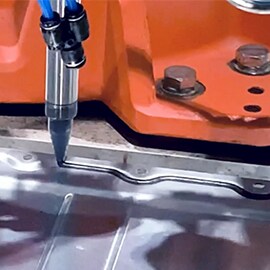
Make assembly more efficient
During assembly, preformed gaskets don’t require dispensing equipment, but they can be challenging to apply using automated equipment. To overcome this, assembly processes either must slow down the manufacturing line or partially hand assemble.
Traditional liquid formed gaskets are very flexible in shape and can be robotically applied, but they can also be challenging to use. They need heat to cure, which is hard for the large surface of the battery pack and once cured they’re permanent. In contrast, 3M™ Sealant SZ1000 can be robotically applied like a traditional liquid formed gasket, but instead of needing heat for curing, it can cure at room temperature.
“This greatly reduces the footprint required for assembly with a smaller number of people,” says Brandon. “Due to its low compression set, the material can be compressed and recompressed multiple times. This means that the pack lid can be opened and closed during the repair process while still maintaining a good seal after recompression. This helps reduce waste, time and equipment needed during repair. ”

-
Use innovative 3M materials to open and close your pack
Making battery packs easier to repair creates many benefits for OEMs. In addition to helping save energy through room temperature curing, it also helps to prevent battery packs from being scrapped due to a single component failure and reduces the need to ship parts around to different locations.
“SZ1000 is just the first of many solutions that 3M is continuing to innovate to help OEMs achieve their goals,” says Brandon. “The bar is set high with designers working to reach the same level of performance while achieving the added pressure of sustainability. It’s a tough challenge, but no different than other hard problems that 3M has solved in the past. Through close collaboration, we believe we can help OEMs solve these problems. ”
If you have any questions or would like to discuss using 3M™ Sealant SZ1000 for EV Enclosure Sealing in your designs, please get in contact with your local 3M representative. For more information visit 3m.com/evbattery
