- Overview
- Products
- 3M™ Scott™ Industrial Air Supplied Products
- Disposable Respirators
- Powered Air Purifying Respirators
- Respirators & Surgical Masks
- Reusable Repirators
- Supplied Air
- Welding Helmet & Respirator Set
- View All Products
- Applications
- Support
- Document Library
- Center for Respiratory Protection
- Find a Sales Rep
- Respirator Trade-in Program
- Training
- View All Support
- Contact Us
Respiratory protection in confined space
-
From potentially toxic atmospheres, to physically hazardous conditions such as extreme temperatures, unstable materials, or the potential for falls, confined spaces often present unseen challenges. Confined spaces are areas that meet all of the following criteria:
- Large enough for workers to enter and perform certain jobs
- Limited or restricted means for entry or exit
- Not designed for continuous occupancy

The know-how to navigate job sites with confined spaces.
Confined spaced. Unique challenges.
No two confined spaces are exactly alike. Type, size and hazards vary greatly, along with different standards, regulations and company policies that can apply to each working environment.
-

Common types of confined spaces
Safely handling entries and exits starts with identifying your work spaces:
- Storage tanks
- Culverts
- Tunnels
- Elevator shafts
- Ductwork
- Trench box
- Utility vaults
Where they are found
Working safely in confined spaces is universal, but different industries present their own challenges:
- Pharmaceutical manufacturing
- Chemical manufacturing
- Food and beverage manufacturing
- Oil and gas
- Waste water treatment
Developing a confined space plan
Be ready before getting to work, so your team can safely handle all entries and exits.
-

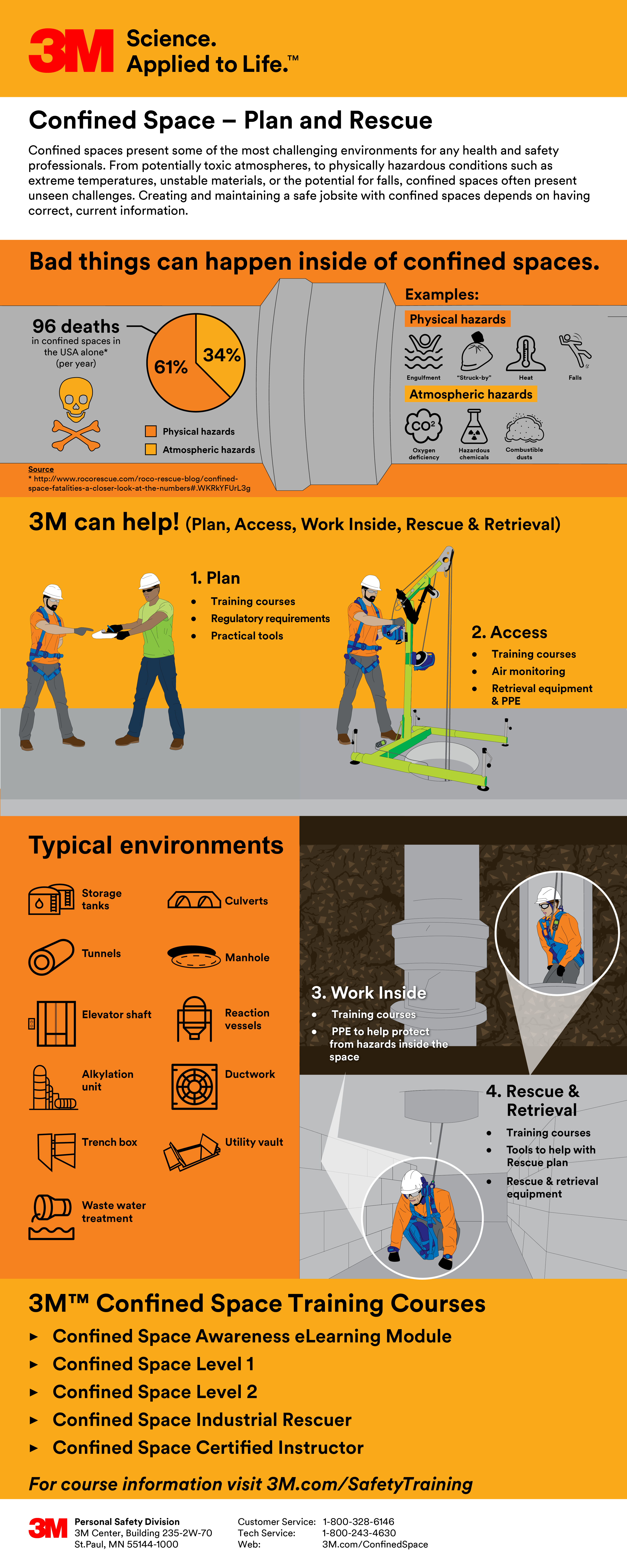
Infographic: Four steps of a plan
Before working in a confined space, always start with:
- A site evaluation
- Identification of proper safety equipment and other required tools
- A trained rescue team that has developed a pre-planning program
- Certified training that involves practice and hands-on experience for all parties who will work in and around a confined space
Plan, Access, Work Inside, and Rescue & Retrieval: Learn what they mean and how to address each step.
-
Additional planning resources
View the video to learn more about the basic elements that make up confined space entry, retrieval and rescue.
Evaluate - Permit Required Confined Space Checklist (PDF, 158.06 KB)

Respiratory products for confined spaces
-
 3M™ Scott Supplied Air Systems (SAR)
Supplied air respirators can be either constant flow or pressure demand. 3M Scott Supplied Air systems are pressure demand and include 3M™ Scott™ Ska-Pak Respirators with an escape cylinder and the 3M™ Scott™ E-Z Airline Respirator without an escape cylinder. Respirators that include a cylinder can be used in environments that are immediately dangerous to life or health (IDLH). SAR users can work up to 300 feet away from the air source and for extended periods of time.
Components:
- Harness assembly
- Facepiece
- Cylinder (3M Scott Ska-Pak Respirators)
-
 Self-contained breathing apparatus (SCBA)
These systems can be used to work in, or escape from, hazards including those that are immediately dangerous to life or health (IDLH). An SCBA offers the greatest user mobility and can be used for work duration up to 75 minutes.
Components:
- Backframe assembly
- Facepiece
- Cylinder

Got questions? Get in touch with our respiratory protection specialists.
Other PPE considerations for confined space
Choosing and using respiratory products
-
Learn about 3M Respiratory Protection products
Disposable filtering facepiece respirators
Reusable respirators
Powered air-purifying respiratorsLearn about all respiratory protection products
-
Support for 3M Respiratory Protection products
