- Overview
- Products
- Featured Products
- Abrasives
- Adhesives, Coatings & Sealers
- Body Filler & Glazes
- Compounds, Polishes & Glazes
- Heavy Duty Truck
- Masking
- Paint Spray Equipment & PPS™
- Tools, Dust Extraction, Accessories
- View All Products
- Applications
- Abrasive Productivity
- Bumper and Plastic Repair
- Corrosion Protection
- Heavy Duty Truck
- Metal Shop
- Paint Shop
- Paint Shop Efficiency
- Paint Finishing & Detail
- Seam Sealers and Coatings
- View All Applications
- Resources
- Training
- Support

In the fast-paced world of collision repair, the paint booth is often a bottleneck. Efficient management of this critical area can significantly enhance productivity and profitability in body shops. One of the primary issues in many repair shops is the lack of structure within the paint area. This can lead to delays, inefficiencies, and ultimately, a slowdown in the repair process.
The most efficient shops are averaging around 12 refinish hours per cycle, completing four to six cycles a day. This translates to about 48-72 refinish hours per day, per booth. However, several shops frequently fall short of this range.
Contrary to popular belief, improving efficiency doesn’t always require investing in additional equipment (i.e., additional paint booth, prep station, or curing equipment). Often, it involves rethinking existing processes and adopting a more strategic approach.
Helpful Tips for Maximizing Efficiency
-
Parts Off Painting
- Removing parts from vehicles before painting can significantly free up booth space. Even if insurance doesn’t cover this practice, the long-term gains in efficiency and productivity can make it worthwhile. For example, removing parts can allow for additional jobs to be processed simultaneously, increasing total refinish hours and the number of booth cycles.
- Other benefits of ‘parts off painting’ include using fewer masking materials, since this practice would skip the step of having to bag a vehicle. Also, shops often run a cycle with one vehicle or part in the booth at a time, which results in inefficient use of booth space and time. Although every job cannot be grouped and not all parts can be removed, grouping those jobs that can be and maximizing real estate can lead to fewer cycles needed to complete the work. The booth would experience less wear and tear and allow for more production time in between maintenance shutdowns.
-
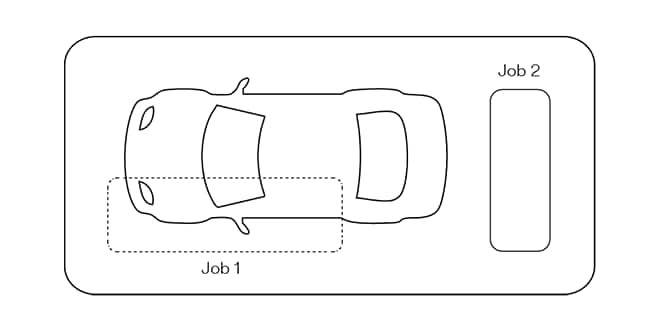 Parts-On
Job 1 - door and fender left on vehicle
Job 2 - bumper from another vehicle
-
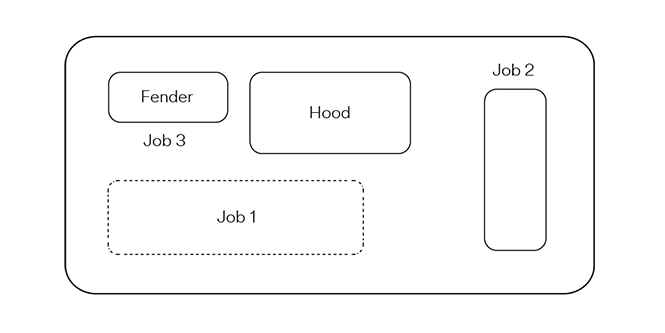 Parts-Off
Job 1 - door and fender removed from vehicle
Job 2 - bumper from another vehicle
Job 3 - fender and hood from third vehicle
-
Minimizing Waste
- Efficient use of materials is crucial as paint materials are getting increasingly more expensive. Overmixing paint not only wastes resources but can also increases costs. Mixing only the necessary amount of paint can further enhance efficiency. Painters often mix two to three extra ounces of sealer, basecoat, and clearcoat per job to avoid running out of paint. By grouping jobs, the extra sealer and clearcoat can be shared between jobs in the same cycle, reducing potential waste. Some paint companies’ mixing software have calculators that can help determine how much paint to mix. Tinting your primers can also help reduce the amount of basecoat that is required for coverage.
- Proper spray gun setup can help maximize transfer efficiency and waste less paint. If a spray gun is set at too high of a pressure or has too wide of a pattern, this results in more paint being wasted as overspray and less paint hitting the panel. This creates a significant loss of transfer efficiency.
- Proper application techniques are also important to minimize waste. When the spray gun is too far away from the panels when spraying, a lot of paint can be wasted in the form of overspray. Also, if a painter doesn’t properly release the trigger as they come off of the panel, a significant amount of paint will be wasted. Lastly, some painters simply apply too much paint. Proper coverage should be checked after each coat. Sometimes an extra coat of paint is applied, when coverage was already achieved with the previous coat.
-
Building a Booth Schedule
- A dedicated booth schedule is essential to maximizing paint shop productivity. The average body shop, regardless of paint line, typically completes roughly 4 booth cycles a day. To get the most out of those cycles, building a booth schedule is recommended. A helpful way of doing this is to attach a dry erase board to the side of each paint booth. Here, shops can write and plan out all of their cycles for the next day. A best practice is to always plan an extra cycle. This extra cycle can be used if all of the other cycles are finished early or if one of the other cycles has to come out of the schedule due to unexpected complications (i.e, missing parts, pinholes, etc.). A filler section should also be included on the booth schedule. This section is where additional small parts that come in throughout the day that need painting, can be added. Painters should look to pull some of these parts from the filler section into openings within the other cycles to maximize efficiency.
- A good practice to adopt to help visualize and pre-plan booth cycles is called “floor staging.” Floor staging is utilizing an area outside of the booth where painters can figure out how to organize parts more effectively. Taping off a “spray zone” on the floor outside of the booth can help painters organize parts more effectively. The “spray zone” is typically 3 feet away from each wall to allow room for the painter to spray. Painters can know exactly how much space they have, allowing them to fit parts efficiently without overcrowding the booth.
- When organizing parts in the booth, maintaining the correct distance is essential. Parts of different colors should be at least 3 feet apart to prevent color contamination, while parts of the same color can be close together. In addition, try to group tri-coats by themselves, when possible.
-
Improving paint booth efficiency requires a combination of strategic planning, practical techniques, and a willing- ness to adapt to new practices. This involves a thorough assessment of current workflows and identifying areas where time and resources are being wasted. By focusing on organization, shops can streamline their operations, ensuring that every step in the painting process is well-coordinated and efficient.
-
 Jason Garfoot3M Global Portfolio Manager - PAS
 Brady Haislet3M Application Engineer
Let us know if you found this article helpful or not by clicking the thumbs up or thumbs down icons.


Thank you for your feedback.
Explore Related Content
-
7 minute read
In this article, discover the OEM requirements for paint and considerations for your repair planning.
-
3 minute read
The evolution of paint colors and techniques continues to push the boundaries of what is possible in the industry. Achieving the right finish now requires a combination of adapting to environmental factors, advanced materials, precise equipment, and expert application skills. As these trends continue, being aware of the technology and techniques will be crucial for success in the increasingly sophisticated world of automotive painting.
-
 3M Collision Repair YouTube Channel
Learn from our 3M Application Engineers as they walk you through key shop processes, efficiencies, and innovative solutions – all aiming to provide a path for higher shop throughput and profitability.
Subscribe to receive 3M Collision Repair emails
At 3M we like to keep collision repair industry professionals, like you, up to date. Receive periodic emails on the latest products, processes, events and promotions. To keep up with what’s new, click to the subscribe button.
