- Overview
- Training
- Products
- Confined Space Solutions
- Fall Protection
- Head & Face Protection
- Hearing Protection & Communication
- Protective Eyewear
- Respiratory Protection
- Welding Safety
- View All Products
- Industry Solutions
- Chemical
- Construction
- Defense
- Fire and First Responders
- Healthcare
- Metal Production and Fabrication
- Mining
- Pharmaceutical
- View All Industries
- Resources
- 3M Integrated Protection Program
- Genuine PPE
- Health & Safety Hazards
- Notifications & Advisories
- Regulations & Standards
- Support

Working together.
Work with 3M to discover how our PPE technologies and services may help encourage workers to wear PPE when exposed to hazards.
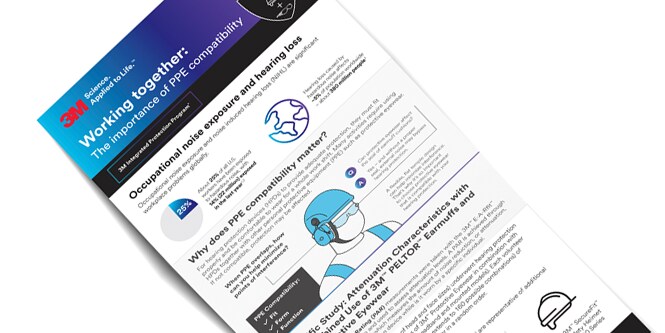
What is the 3M Integrated Protection Program*?
PPE is most effective when worn properly, 100% of the time exposed to hazards – and it works best when it works together.
Personal protective equipment (PPE) is often selected to protect workers against specific hazards. Workers seldom encounter hazards one at a time, which means they often need to wear multiple types of PPE at once. This is why we’ve introduced the 3M Integrated Protection Program*, a portfolio of personal protective equipment (PPE) technologies and services which may work together to help address one or more of workers’ various needs, including comfort, fit, compatibility, communication, or performance.
*3M Integrated Protection Program refers to 3M’s portfolio of personal protective equipment (PPE) technologies and services that may be used by workers for their various needs, including comfort, fit, compatibility, communication, or performance. The depicted combinations are representative examples of which technologies may work together, but these combinations may not be appropriate for all work environments. Employers are responsible to select PPE combinations based on employee risk assessment for hazards and ensure that fit testing of combinations are conducted while wearing all appropriate PPE.
Wear time is the percentage of time workers actually wear their required PPE vs. the amount of time they should wear it to achieve the desired protection.
How can we encourage workers to wear all their required PPE, all shift long? By paying careful attention to PPE comfort, communication and performance from the start, and using fit testing to help validate that PPE works together.
-
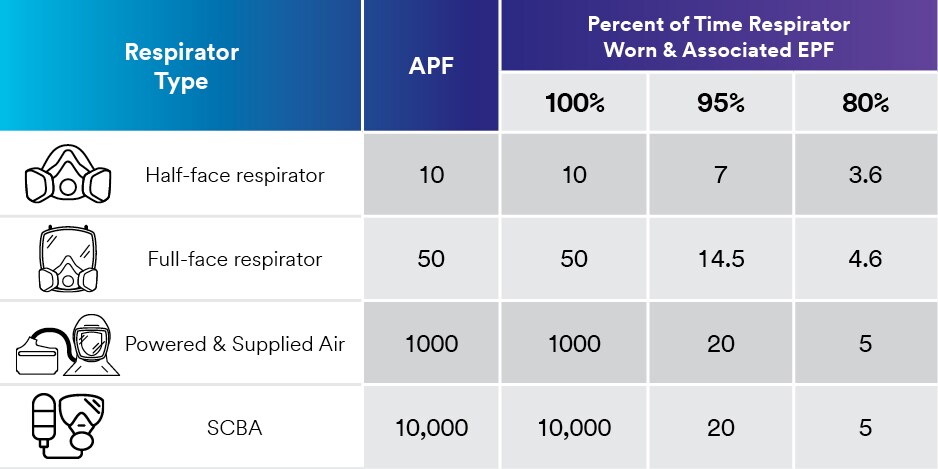 Assigned Protection Factor (APF)
The Assigned Protection Factor (APF) used to help select respiratory protection assumes that workers wear their required respirator properly 100% of the time they may be exposed while on the job. The Effective Protection Factor (EPF) is the actual protection factor achieved based on the wear time for each worker.**
-
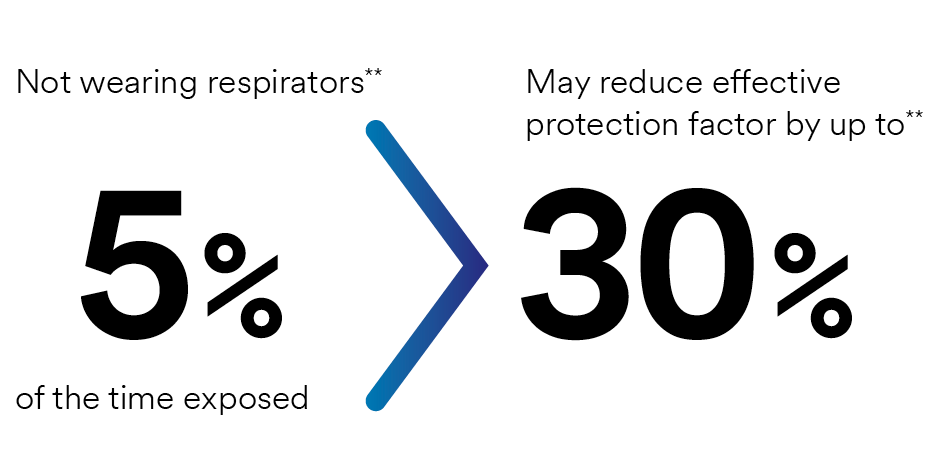 Impact on respiratory protection EPF
For example, removing a respirator for just a few minutes to communicate may impact respiratory protection.**
**Assuming a half face piece respirator with an APF of 10, 5% of an 8 hour workshift is 3 min/hour, or 24 min/day non-weartime. Colton, Craig. Respiratory protection. Fundamentals of Industrial Hygiene Ed. Barbara Plog. Itasca: National Safety Council, 2012, 678-679.
-
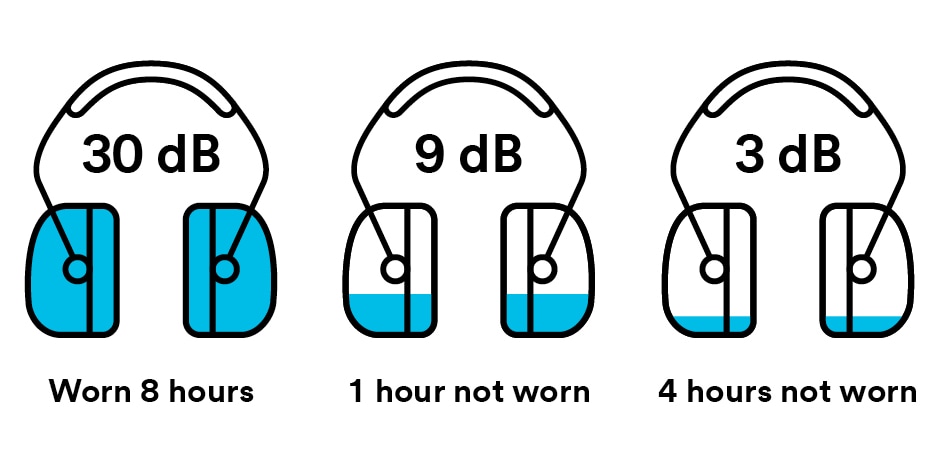 Effective Protection Factor
Effective protection drops when hearing protectors are not worn. See the impact of just 1 hour without hearing protection over an 8 hour shift. Example above, based on 95 dBA TWA exposure and using NIOSH Recommended Exposure Limit of 85 dBA and 3 dB exchange rate.
Why might workers not wear their PPE 100% of the time exposed?
-
Communication
Communicating clearly while wearing hearing and respiratory protection can be challenging for some users. If workers remove PPE to speak, protection may be compromised.
How to encourage wear time?
Features to help allow communication without removing PPE. -
Compatibility
Workers may need to wear multiple types of PPE for long periods of time, which may interfere with each other when worn together.
How to encourage wear time?
Select PPE designed to help fit a wide variety of workers, and use fit testing to ensure PPE works together. -
Comfort
Heat, humidity and lack of breathability may cause discomfort. So can chafing or pressure from overlapping PPE.
How to encourage wear time?
PPE with features such as pressure diffusion technology to enhance comfort both individually and in combination. -
Performance
From fogging eyewear to interrupted communications, PPE not working together can be cumbersome and can interfere with the job at hand.
How to encourage wear time?
Certain PPE features may help reduce workers’ need to adjust their PPE – options include anti-fog coatings for protective eyewear, technologies that allow for communication, or PPE that allows welders to keep working without changing PPE between tasks.
-
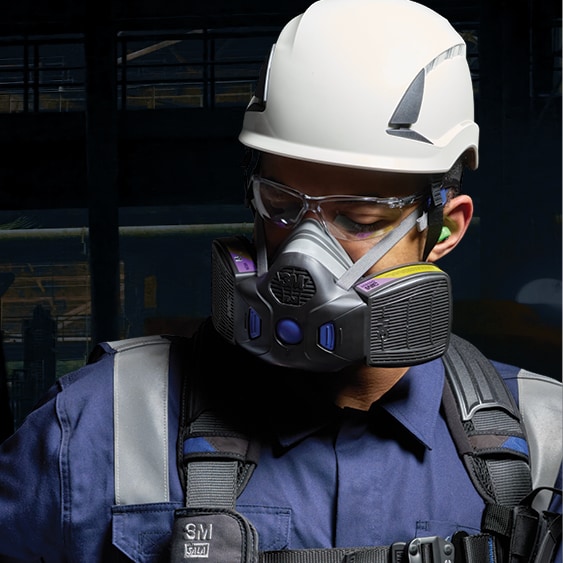
Fit
Fit can have a significant impact on protection. PPE that isn’t properly sized or adjusted may not perform as intended – especially if other types of PPE are interfering with the proper donning.
How to encourage wear time?
PPE that fits properly while worn together, both for comfort and for protection against a variety of hazards. Fit testing should be conducted with all necessary PPE worn together.
-
Personal Attenuation Rating (PAR) measurements were taken with the 3M™ E-A-Rfit™ Dual-Ear Validation System and used to assess attenuation levels. A PAR is achieved through hearing protector fit testing which measures the amount of noise reduction, or attenuation, of a selected hearing protection device while is it worn by a specific individual.
Thirty volunteers (with a wide range of head and face sizes) underwent hearing protection testing while wearing various styles of 3M™ Protective Eyewear in combination with various 3M™ PELTOR™ Earmuffs (both headband and mounted models). Each volunteer was tested with 42 combinations (which extends to 160 possible combinations) of earmuffs with and without protective eyewear in a random order.
-
How to select the 3M PPE options***
-
 Identify task hazards and controls
 -
 Consider environment, comfort, compatibility, communication and wearability needs
 -
 Select the appropriate comprehensive PPE options
 -
 Fit test to help ensure that PPE fits and works together
See potential PPE options***
Once you’ve made your selections, remember to verify the compatibility by performing appropriate fit testing of PPE both alone and in combination.
***The depicted combinations are representative examples of which technologies may work together and is not comprehensive. Some environments or situations might require different or additional PPE. Selecting PPE is the responsibility of the employer and must be based on the work environment, specific hazards, and tasks involved. Fit testing is required to ensure that PPE combinations fit the individual wearer.

-
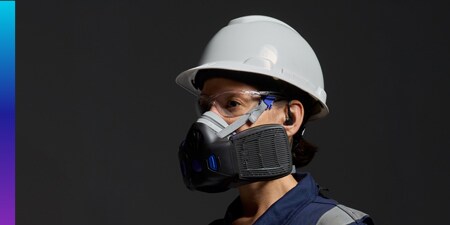 Communication technologies
3M™ Secure Click™ Half Facepiece Reusable Respirator with speaking diaphragm designed to help provide easy communication.
3M™ PELTOR™ Professional In-Ear Communication Headset PIC-100 enables clear, hands-free protective communication in noisy environments
-
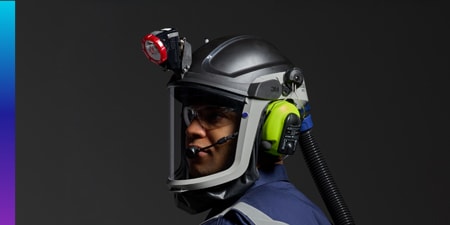 Compatibility technologies
3M™ M-Series PAPR Helmet & Helmet Assemblies integrates respiratory, head, eye, face and hearing protection.
3M™ PELTOR™ LiteCom Plus Headset provides hearing protection with environmental listening and two-way communication.
-
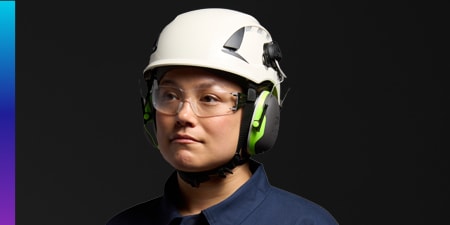 Fit technologies
3M™ SecureFit™ 400 Series Safety Glasses features 3M™ Pressure Diffusion Temple Technology – temples flex and self-adjust to the size of the wearer’s head
3M™ Pressure Diffusion Technology, as featured in certain 3M™ SecureFit™ X5000 Series Safety Helmets – flexes and self-adjusts to the size of the wearer’s head, reducing forehead pressure and increasing comfort for all-day wear
-
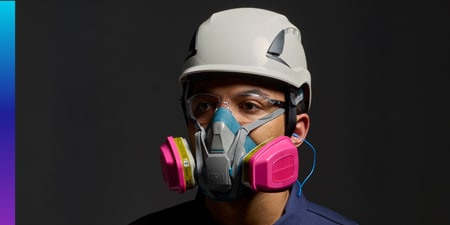 Comfort technologies
3M™ Rugged Comfort Quick Latch Half Facepiece Reusable Respirator has a resilient silicone face seal and helps provide comfort, durability, and stability with a soft but firm seal
3M™ SecureFit™ X5000 Series Safety Helmet features 3M Pressure Diffusion Technology, providing 30% pressure reduction on the forehead to help increase comfort for all-day wear compared to previous generation 3M hard hats.
-
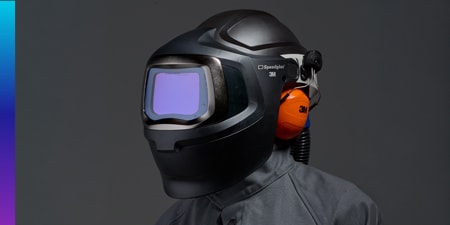 Performance technologies
3M™ Adflo™ Powered Air Purifying Respirator (PAPR) System with 3M™ Speedglas™ 9100 MP Welding Helmet integrates protection against welding and respiratory hazards, with head, face and optional hearing protection.
-
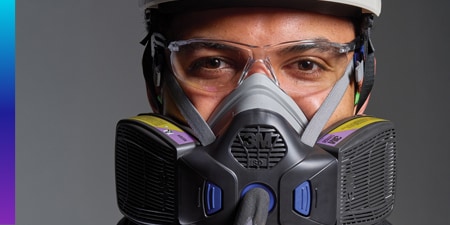 Working together
Help boost safety and health on the job
Work with 3M to discover how our PPE technologies may help encourage workers to wear PPE when exposed to hazards.
Help ensure a proper fit
Fit can have a significant impact on protection. Fit testing is a best practice, and is often required by standards and regulations to verify that PPE is providing the expected level of protection. There are many factors that affect how well PPE fits the individual wearer, including size and shape of the wearer and other equipment or clothing worn at the same time.
-

A tight-fitting respirator needs to seal to a wearer’s face. Otherwise, contaminated air can enter the wearer’s breathing zone.
Applies to all tight-fitting respirators, including:
- Filtering facepiece particulate respirators
- Half and full facepiece respirators with filters and/or cartridges
- Tight fitting facepieces connected to PAPRs or supplied air respirators, or used with SCBAs
-

If earplugs do not fit the wearer’s ear canals or earmuffs the wearer’s head well, external noise may bypass the hearing protector, which can lead to noise-induced hearing loss over time. A benefit of hearing protector fit testing is that it can help identify persons at risk for overexposure to noise due to improper fit.
Applied to:
- Disposable and reusable earplugs
- Earmuffs
- Protective communication devices
-

All eye protection needs to provide a wide field of view, security of fit, and good coverage.
- Protective goggles should fit snugly with no gaps between the protective goggles and the wearer’s face.
- Protective eyewear should have minimal gaps between protective eyewear and the wearer’s face.
-

Worker comfort, fit, and ease of use are key considerations in the selection of a full body harness. Full body harnesses distribute fall arrest forces across the shoulders, upper thighs, chest, and pelvis. Therefore proper fit is critical. Harnesses should be chosen based on the task and the size of the wearer, and then donned, fitted and adjusted properly before each use.
Applies to all fall protection harnesses.

Fit Academy: Schedule a free session
Engage your workforce with fit testing awareness training. This interactive workshop provides valuable information on respiratory, hearing, eye and fall protection fit assessments, PPE comfort and fit selection options, and best practices to help your health and safety program.
Contact a 3M Specialist
