- Overview
- Products
- Applications
- Cable Jacket Repair
- Data Centers
- Electrical Construction
- Maintenance and Repair
- Wire and Cable Management
- Commercial and Industrial
- Harsh Environments
- View All Applications
- Resources
- Construction Services
- Energy Articles
- Electrical Tape Selector
- Medium Voltage BIM Objects
- View All Resources
- Training
- Support

The benefits of Cold Shrink Technology vs. Heat Shrink Technology
Author: Bill Taylor, Retired 3M Product Development Engineer
Contact Person: George Fofeldea, 3M Application Engineer
Published October 2022
A Brief History of Cold Shrink
Heat shrink and cold shrink cable accessories were developed in the 1960s due to the introduction of rubber and polyethylene insulated cables. Both technologies use cross-linkable material that is expanded and sold in the expanded state. Heat shrink technology uses heat to shrink onto the cable, and cold shrink technology uses the mechanical properties of the rubber that allows it to shrink onto the cable with no external heat. Since both technologies shrink onto the cable, they may appear similar, but their key performance characteristics are very different. Before we look in more detail at how these technologies work, we will briefly look at 3M’s history with cold shrink products.
Not only did 3M invent cold shrink technology, we have worked continually over many decades to improve technology and extend its capabilities. In the ensuing years since developing cold shrink technology in 1968, 3M has made advancements in cold shrink splices and terminations for medium voltage and 69/72.5 kV applications.
The clear success of cold shrink technology has led many other companies to offer similar cold shrink products. But 3M’s long history with and experience in cold shrink products gives 3M expertise in cold shrink technology not held by other companies when it comes to developing new cold shrink products. In fact, many of our cold shrink medium voltage products have been in service for more than 40 years, a level of long standing
Explanation of How the Technologies Work
Let’s look in more detail at how each technology works, so we can understand the differences between heat shrink technology and cold shrink technology and how the differences apply to performance.
-
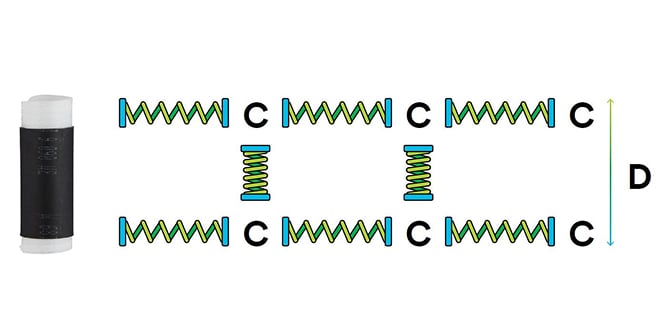
Figure 1.
Cold shrink products typically use rubber materials such as silicone or ethylene propylene diene monomer (EPDM), whereas heat shrink typically uses more plastic-type materials such as ethylene vinyl acetate (EVA), Kynar® polyvinylidene fluoride (PVDF) or other similar types of material. All these materials are crosslinkable, which allows them to be stretched and then shrunk back onto the cable.
The cross-linking of these materials form bonds between the long-chain molecules, which act as springs that try to shrink the material back to its original diameter (see Figure 1). In fact, none of the materials will actually return to its original diameter, and the distance that they shrink to—above the original diameter—is called the permanent set of the material. All the products are designed with this permanent set taken into account when providing the published application range of the product. For both cold shrink and heat shrink materials, there is a minimum and maximum diameter for each accessory. The minimum diameter is based on the permanent set of the material and the maximum diameter is based on a maximum expansion percentage in application to minimize the chance of splitting.
Heat shrink materials have crystalline regions in them that keep the material rigid. To manufacture the products, the material in the final state (tube, boot, etc.) is heated above the melt temperature of these crystalline regions, which allows the material to be expanded. Once in the expanded state, the product is cooled down so the crystalline regions reform and keep the product expanded. To install the heat shrink products, the product is heated to a temperature that melts the crystalline regions so the cross-link bonds can work and shrink the product. Once the product is shrunk in place, the heat is removed and the crystalline regions form once again, causing the product to remain in its last shrunk shape. Typically, these crystalline regions will melt at between 90 and 110 degrees C. Since these products are installed on the outside of the cable insulation, they should not see these temperatures during normal operation.
Because of the crystalline regions, heat shrink products exert no inward pressure once it is shrunk into its final configuration, which is why heat shrink products use mastic and adhesive to provide environmental seals. This means that heat shrink products do not expand and contract with the cable insulation, as it goes through load cycles. Over time, this may cause issues with heat shrink accessories. When a cable thermally expands, it will also expand the heat shrink material,
-
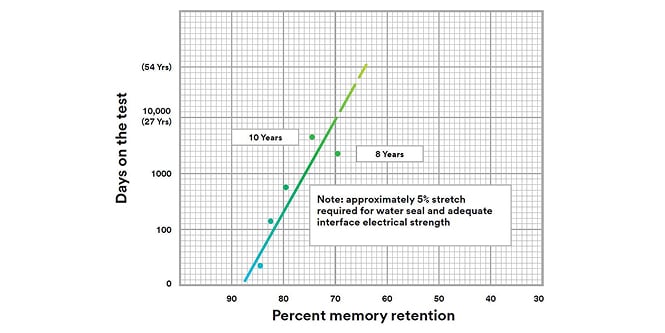
Figure 2.
but because of the rigidity of heat shrink and the crystalline regions, when the cable insulation shrinks due to less current and lower ambient temperature, the heat shrink material will not shrink with it.
After about 8-10 years, this may cause an interface issue on medium voltage accessories. One customer used large heat shrink splices in an aerial application (because cold shrink splices were not available in a size that would accommodate their extra long connector), but after 8 years in service, frequent failures in the form of flashes down the interface would occur in cold weather.
Cold shrink products are different from heat shrink products in that the cross-linked materials are always trying to get to a smaller diameter and therefore always exert inward pressure on the object they are shrunk on. They exert inward pressure on the core they are shipped on, so the core has to be designed to not collapse with the inward pressure of the product. Once the core is removed, the accessory is shrunk onto the cable without any heat or any other external force. Once on the cable, cold shrink products are designed to provide inward pressure for more than 50 years, as shown in Figure 2. This inward pressure allows the cold shrink products to expand and contract with the cable. As the cable expands with higher temperatures due to ambient temperature and higher currents, the cold shrink expands outward, which slightly increases the interface pressure between the cold shrink product and the cable. As the cable contracts when the load and/or ambient temperature decreases, the cold shrink products also contract with the cable to maintain the high interface pressure between the cable and the product. The inward pressure provides excellent electrical performance and an excellent environmental seal, without the use of mastics or adhesives. Mastics can be used to increase the application range or to build up the diameter of a cable so it is in the application range of the cold shrink product, but are not required to obtain an excellent environmental seal.
All of the reasons mentioned above is why 3M recommends cold shrink cable accessories for medium voltage applications.
Advantages of Cold Shrink Technology Over Heat Shrink Technology
In addition to the fact that cold shrink technology provides excellent interface pressure and a ‘living seal’ versus heat shrink technology, which provides no interface pressure and must use mastic and/or adhesives for sealing, cold shrink products offer many other advantages.
After heat shrink products are installed, they should not be moved or bent, as this can compromise the environmental seal or the insulation-to-insulation interface for products. The crystalline regions in the heat shrink material make it very rigid and hard and prevent it from being able to shrink onto the cable or from exerting any inward pressure. Cold shrink products, however, can be bent up to the maximum bending radius of the cable and will continue to exert inward pressure on the cable and continue to perform. Figure 3 shows 69 kV terminations that are in the bent position and performing.
Heat shrink medium voltage accessories typically may be installed in many more pieces than comparable cold shrink accessories. This may lead to more installation errors as there are more pieces to misplace or forget to install. Also, these additional pieces add to the installation time, which is considerably longer for heat shrink products than cold shrink products. Figure 4 shows the heat shrink components required for an outdoor, two-skirt termination, and Figure 5 shows that to accomplish the same result there is only one cold shrink component to install. Figure 6 shows the components of a MV heat shrink splice kit, and Figure 7 shows the components of a corresponding MV cold shrink splice kit.
-
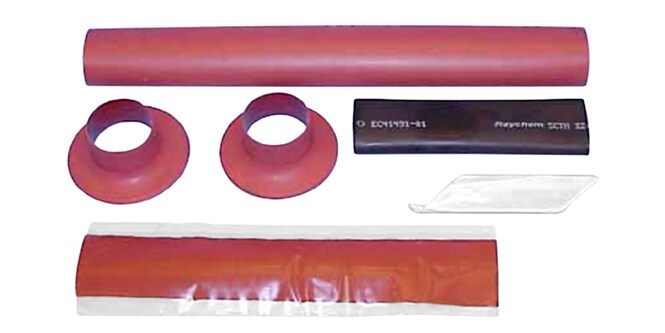
Figure 4.
3M™ Medium Voltage Heat Shrink Termination
-
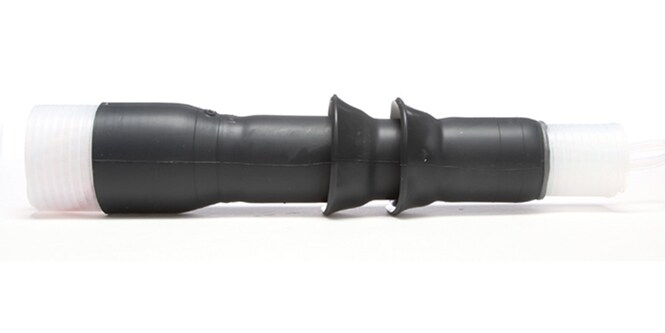
Figure 5.
3M™ Cold Shrink QT-III Silicone Rubber Termination 7642-S-2
-
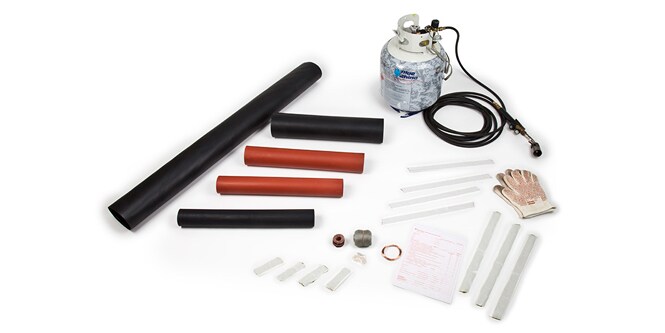
Figure 6.
3M™ Medium Voltage Heat Shrink Splice Kit
-
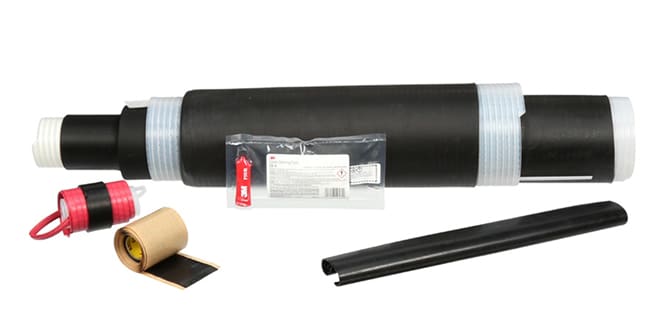
Figure 7.
3M™ QS-III Cold Shrink Splice Kit 5467A
-
 Reliability
 -
Cold Shrink Advantages
Provides excellent interface pressure and “living seal” much higher interface pressure than that of any other accessory, which greatly helps in assuring a long life for the accessory
-
Heat Shrink Disadvantages
Provides no interface pressure and must use mastic and/or adhesives for sealing and can fail over time due to the thermal expansion and contraction of the cable
-
 Functionality
 -
Cold Shrink Advantages
- Cold shrink can be bent up to the maximum bending radius of the cable and will continue to exert inward pressure on the cable and continue to perform
- Available for transmission cables up to 245 kV
- The material used for the outer portion of cold shrink terminations, silicone rubber, is inherently hydrophobic and track-resistant
-
Heat Shrink Disadvantages
- Cannot be moved or bent, as this may compromise the environmental seal or the insulation-to-insulation interface for medium voltage products
- Limited to a maximum of 72 kV
- Heat shrink termination materials must have additives that make them hydrophobic and track resistant
-
 Installation
 -
Cold Shrink Advantages
- One piece to install; can be done quickly and efficiently (timed lab studies confirm the speed advantage)
- No heat source required
- No hot work or open flame permit required
- No exhaust fans required in vaults
- Shorter installation time
- Cold shrink splices or terminations shrink uniformly by itself when removing the core and are easily positioned
- No gas emissions
-
Heat Shrink Disadvantages
Many pieces to install, which may contribute to installation errors depending on the experience of the technician and takes more time
- Heavy gas bottle or heat source required; workers and other accessories and cables are at risk of possible injury
- Hot work or open flame permit is required
- Exhaust fans may be required to ensure combustible gasses don’t accumulate during the installation and additional proper personal protection equipment (PPE) may be needed based on your company practices
- Longer installation time
- Uniform shape and wall thickness depend on proper radial heat application in tough working conditions
-
 Cost
Cost -
Cold Shrink Advantages
Less expensive overall
More cost effective and quicker to install, better electrical performance and better reliability.
-
Heat Shrink Disadvantages
More expensive overall
Longer installation time, permits, permitting time, maintenance, and additional products such as hot melt mastics and adhesives
Installation Tips and Tricks
-
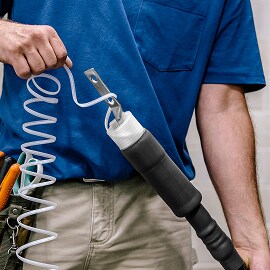
- Heat shrink products must be heated uniformly all the way around to get a good installation and to make sure all the mastic flows properly to provide a seal. When heat is applied to heat shrink materials it can be unevenly heated, like from the front side or top side only, due to tough working conditions, experience of the installer, a tight cable compartment or other constructions and cables, that are in the way for the torch. This results in burning marks, significant insulation wall thickness differences, but also hotmelt adhesives and mastics that are not activated due to lack of heat through the heat shrink material. Once a heat shrink accessory is installed, it must not be bent because the seal could be compromised.
- Cold shrink accessories are typically a one piece rubber design that shrink on to the cable when the support core is removed. The installation is easy and simple, as aligning the accessory in the correct position and removing the support core is all that is required. There have been a few complaints that sometimes the support core gets stuck. The following tips and tricks will keep the core from getting stuck and allow for an easy, successful installation. First make the cold shrink accessory slowly shrink until it is just touching the cable. The accessory can then be rotated to align it with the tape marker. When the accessory is positioned, removing a few additional wraps of the support core will secure the accessory. The best way to remove the support core is to move the end of the core around the cable counter clockwise and then apply a short pull. This method keeps the support core away from the cable and connector or lug. Be careful, if you make long pulls on the core, it can cause the core to dig into the cable. If this occurs, perform additional wraps of the core ribbon around the cable counterclockwise to keep the support core ribbon from getting stuck. Also, while removing the support core, please only touch the support core ribbon and not the accessory itself, as this will allow the accessory to install in the correct location.
3M Cold Shrink Quality
Because 3M invented cold shrink technology and has been in the cold shrink business for more than 50 years, we have more experience than most, which is tremendously valuable when designing cold shrink products. 3M’s preferred technology for medium voltage cable accessories is cold shrink, as we believe it is the better technology for this application.
-
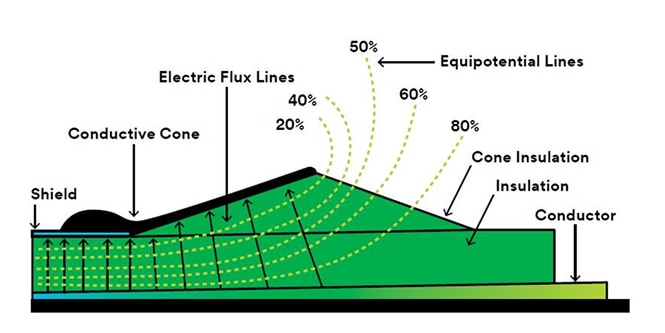
Figure 8.
All of 3M’s medium voltage cold shrink terminations use high dielectric stress control because it is one of the best methods of electrical stress control. Most cold shrink terminations sold by other manufacturers use geometric stress control for medium voltage terminations, because it is easier to develop and manufacture. The following electrical stress plots show terminations using geometric stress control in Figure 8 and high dielectric stress control in Figure 9.
As we know, in electrical stress plots, the closer the equipotential lines are together, the higher the electrical stress, because stress is just voltage divided by distance. The closer the lines are together, the more voltage differential you have over a shorter distance, and therefore higher stress. From the plots, it is obvious that high dielectric stress control spreads out the equipotential lines so that the surface stress on the termination is significantly lower. The geometric stress control plot shows how this type of stress control overcomes the electrical stress with extra insulation, but the equipotential lines are still very close together, so the
-
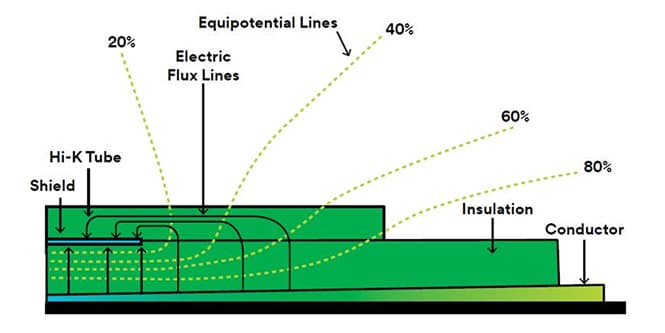
Figure 9.
surface stress on the termination is much higher, which can lead to tracking in highly contaminated areas and requires a longer termination to meet the electrical standard requirements. A white paper by 3M entitled “Geometric vs. Capacitive Stress Control: choosing cable termination accessories to help reduce electrical stress,”2 provides testing data comparing geometric terminations versus high dielectric stress control terminations. The data shows that the high dielectric terminations perform better.
Another type of electrical stress control is resistive. Resistive stress control is very installer dependent and is used in some heat shrink accessories. This type of stress control uses direction sensitive tape that has to be installed so that there are no air voids at the semiconductor step of the cable. Resistive stress control also requires a longer length to perform properly, so the accessories are typically longer. As with most heat shrink accessories, taping correctly is a very important part of the installation process.
-
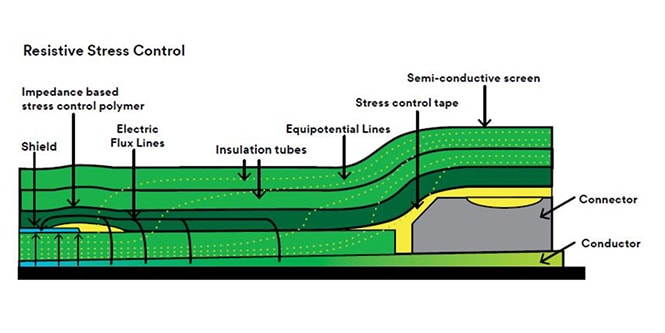
Figure 10.
3M offers multiple cold shrink splice options so customers can choose the best one for their application. Splices can use either geometric or high dielectric electrical stress control. Compared to competitors, 3M offers lower-cost options with more component parts or fully integrated options with fewer parts. More parts provide more opportunity for installer errors. Also, 3M splices have more installation tolerances and provide good electrical and thermal performance. All 3M splices have long, reliable histories. 3M invented the first cold shrink splice and has developed additional splices as required by the industry. With 3M, you can choose the splice or splices that work best for your applications and be confident that they will be easy to install and reliable.

Summary
Cold shrink technology has many advantages over heat shrink technology, from ease and speed of installation to performance and reliability. These advantages come from the design of the accessory and the material properties. From our experience and the experience of many end users who exclusively use cold shrink medium voltage accessories, cold shrink accessories are the better option for all medium voltage cables. Join the future. Discover what cold shrink technology can do for you.
Technical Information: The technical information, guidance, and other statements contained in this document or otherwise provided by 3M are based upon records, tests, or experience that 3M believes to be reliable, but the accuracy, completeness, and representative nature of such information is not guaranteed. Such information is intended for people with knowledge and technical skills sufficient to assess and apply their own informed judgment to the information. No license under any 3M or third party intellectual property rights is granted or implied with this information.
Product Selection and Use: Many factors beyond 3M’s control and uniquely within user’s knowledge and control can affect the use and performance of a 3M product in a particular application. As a result, customer is solely responsible for evaluating the product and determining whether it is appropriate and suitable for customer’s application, including conducting a workplace hazard assessment and reviewing all applicable regulations and standards (e.g., OSHA, ANSI, etc.). Failure to properly evaluate, select, and use a 3M product in accordance with all applicable instructions and with appropriate safety equipment, or to meet all applicable safety regulations, may result in injury, sickness, death, and/or harm to property.
Warranty, Limited Remedy, and Disclaimer: Unless a different warranty is specifically stated on the applicable 3M product packaging or product literature (in which case such warranty governs), 3M warrants that each 3M product meets the applicable 3M product specification at the time 3M ships the product. 3M MAKES NO OTHER WARRANTIES OR CONDITIONS, EXPRESS OR IMPLIED, INCLUDING, BUT NOT LIMITED TO, ANY IMPLIED WARRANTY OR CONDITION OF MERCHANTABILITY, FITNESS FOR A PARTICULAR PURPOSE, OR ARISING OUT OF A COURSE OF DEALING, CUSTOM, OR USAGE OF TRADE. If a 3M product does not conform to this warranty, then the sole and exclusive remedy is, at 3M’s option, replacement or repair of the 3M product or refund of the purchase price. Warranty claims must be made within one (1) year from the date of 3M’s shipment.
Limitation of Liability: Except for the limited remedy stated above, and except to the extent prohibited by applicable law, 3M will not be liable for any loss or damage arising from or related to the 3M product, whether direct, indirect, special, incidental, or consequential (including, but not limited to, lost profits or business opportunity), regardless of the legal or equitable theory asserted, including, but not limited to, warranty, contract, negligence, or strict liability.
Disclaimer: 3M industrial and occupational products are intended, labeled, and packaged for sale to trained industrial and occupational customers for workplace use. Unless specifically stated otherwise on the applicable product packaging or literature, these products are not intended, labeled, or packaged for sale to or use by consumers (e.g., for home, personal, primary or secondary school, recreational/sporting, or other uses not described in the applicable product packaging or literature), and must be selected and used in compliance with applicable health and safety regulations and standards (e.g., U.S. OSHA, ANSI), as well as all product literature, user instructions, warnings, and limitations, and the user must take any action required under any recall, field action or other product use notice. Misuse of 3M industrial and occupational products may result in injury, sickness, or death. For help with product selection and use, consult your on-site safety professional, industrial hygienist, or other subject matter expert. For additional product information, visit www.3M.com.
Content Disclaimer: Bill Taylor, a former 3Mer and a member or officer of IEEE/PES/ICC, has participated and provided information in this white paper. Bill has also received compensation from 3M in connection with his participation and the information that he has provided herein.
References
1 “Test and Field Experience with Elastomeric Terminations” by H. C Hervig, 3M
2 “Geometric vs. Capacitive Stress Control: choosing cable termination accessories to help reduce electrical stress” by George Fofeldea
