
A more efficient cryogenic insulation. Reduce your boil-off rate, increase your tank capacity, lower your operating expenses, and improve your returns on invested capital.
3M™ Glass Bubbles for Cryogenic Insulation
-
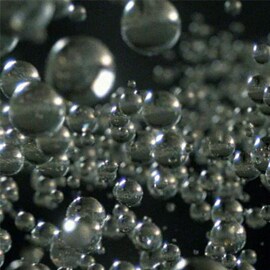
Liquified gases like hydrogen, nitrogen, liquid natural gas, oxygen, and argon are usually stored below their boiling points (i.e. 20 Kelvin for liquid hydrogen) in tanks with two walls and an annular space filled with insulating material. This is known as cryogenic or cold storage. Historically, an expanded volcanic glass called perlite was often used to fill the annular space in cryogenic storage vessels.
3M Glass Bubbles offer significant advantages over perlite when it comes to thermal efficiency and durability. In some cryogenic tank designs such as rail and over-the-road, they can also provide weight advantages depending on specified density. With their engineered spherical glass shape, low thermal conductivity, and high strength-to-density ratio, 3M Glass Bubbles offer a more effective alternative to traditional cryogenic insulation.
As we look towards a future where the hydrogen economy becomes increasingly important, the economic impact of transporting and storing this fuel source will continue to grow. By dramatically reducing the boil off emissions from liquid hydrogen storage tanks, 3M Glass Bubbles can become an integral part of the global shift from fossil fuels to sustainable hydrogen-based energy sources.
-
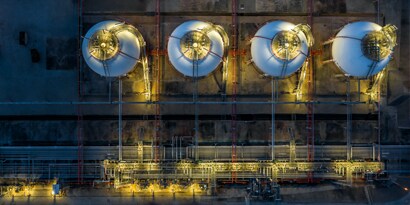 Thermal Insulation
The low thermal conductivity of 3M Glass Bubbles makes them ideal for cryogenic insulation. In cryogenic storage applications, boil-off rate (the rate that a liquid gas is lost via evaporation) is a primary consideration.
3M Glass Bubbles can help reduce the boil-off rate considerably, including up to 46% reduction for hydrogen in large storage volume, concentric storage spheres.
-
 Design Flexibility
3M Glass Bubbles’ excellent thermal performance and low bulk density can reduce the insulation requirements in the tank’s annulus. This may increase your tank’s capacity or reduce the design footprint of your tank while maintaining similar storage volumes.
Plus, the strength and shape of 3M Glass Bubbles make them more durable and easier to work with. This all adds up to greater flexibility for your application.
-
 Supply Chain
The 3M supply chain, global sales team, and customer service network offer the efficiency and support you need to optimize your cryogenic storage insulation needs. We offer packages in multiple formats to help you meet your requirements.

-
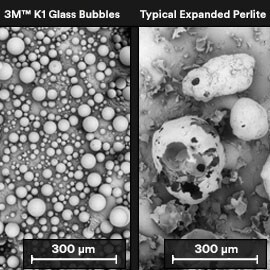
3M Glass Bubbles vs. Perlite
In addition to their excellent thermal performance — which reduces boil-off rate vs. perlite — 3M Glass Bubbles offer notable advantages in cryogenic storage applications.
- Consistent performance over time. Vibrations during transport and typical thermal expansion and contraction of the tank walls can compact perlite. This creates cold spots that generate increased boil off and loss of valuable cryogens, ultimately requiring repair or replacement of the tank. Because of the spherical shape of 3M Glass Bubbles, they don’t experience compaction or settling caused by vibrations or thermal expansions and contractions.
- Rugged strength to withstand thermal cycling. The high strength-to-density ratio of 3M Glass Bubbles means they can withstand the forces exerted during cryogen filling and emptying.
- Lower weight and volume. The spherical shape, low density, and thermal performance of 3M Glass Bubbles helps reduce both the weight and volume of the insulation required in cryogenic storage applications. This allows for potentially more net storage of cryogen and helps reduce fuel costs during transport.
-
3M Glass Bubbles vs. Multi-layer Insulation
MLI (superinsulation) is used for cylindrical tank construction, typically to transport cryogens. These systems can be sensitive to thermal shock and vibrations, which can lead to degradation of the insulation and potentially cause cold spots. Additionally, MLI is a fixed insulation solution that doesn’t lend itself to easy removal or modification.
- 3M Glass Bubbles, which are free flowing, can be installed into the existing annulus around the existing MLI insulation — making them a unique solution to refurbish these types of tanks without removing the MLI, or cutting or modifying the tank structure.
Resources
-

The 50,000 gallon hydrogen storage tank at NASA’s Stennis Space Center was constructed in the early 1960s. This spherical cryogenic storage (Horton) vessel consisted of double walls with an evacuated perlite-filled annulus. In the early 2000s, NASA began looking for ways to reduce the amount of hydrogen they were losing throughout their liquid hydrogen storage systems, due to evaporation. Under the leadership of the Cryogenics Test Laboratory team at the Kennedy Space Center, they conducted a trial using 3M Glass Bubbles for thermal insulation in the tank. Over 10+years of continuous operation, their technical publications show an average 44% reduction in boil-off.
-
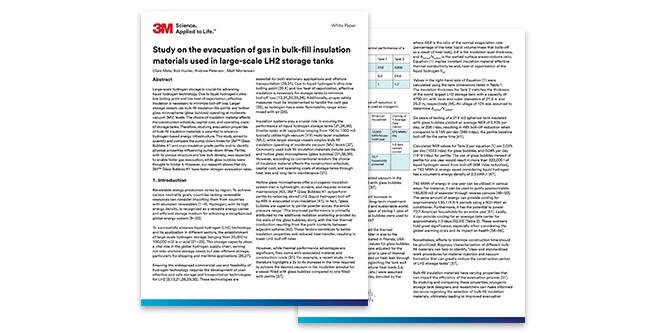
This study aims to identify the physical properties influencing pump-down times for insulated cryogenic hydrogen storage by quantifying and comparing insulation grade perlite and 3M™ Glass Bubbles K1. The results show a real need to re-evaluate our conventional understanding of gas evacuation in bulk-filled insulated cryogenic storage systems.
Product Information & Support
View 3M™ Glass Bubbles K1 product details or contact the product support team for assistance.
